China's Appointed Panchen Lama Calls for Religious Work in Tibet to Align With Assimilation Law
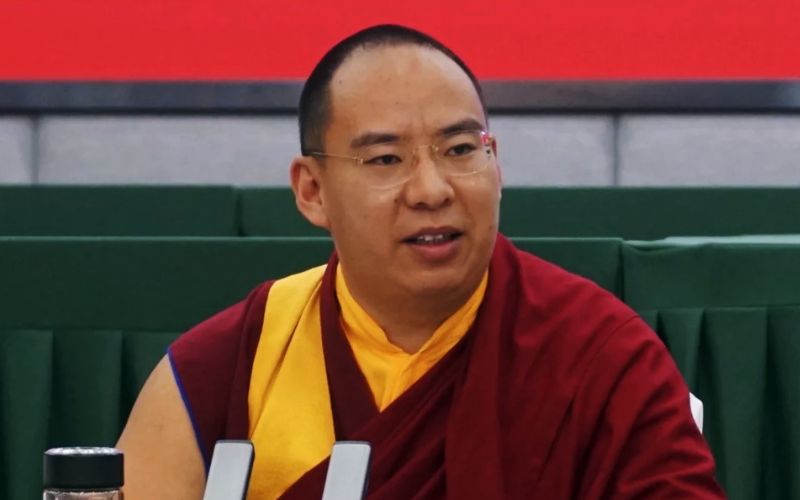
China’s appointed Panchen Lama, Gyaltsen Norbu, has called for all religious and other work in Tibet to align with the Chinese Communist Party’s agenda and the newly enacted Ethnic Unity and Progress Promotion Law. His remarks highlight Beijing’s expanding efforts to bring Tibetan Buddhist institutions under state control, raising serious concerns about religious freedom, Tibetan identity, and the survival of Tibet’s distinct cultural heritage.
Gyaltsen Norbu Calls for Religious Institutions to Follow the Party’s Agenda
On September 30, 2026, Gyaltsen Norbu, the Chinese government-appointed Panchen Lama, called for all religious and other work in the Tibet Autonomous Region (TAR) to remain aligned with the overall objectives of the Chinese Communist Party and the Chinese state.
According to a report by China’s state news agency Xinhua on October 10, Norbu made the remarks while presiding over a meeting of the TAR branch of the Buddhist Association of China. He called for the in-depth study and public promotion of relevant laws and regulations, including the recently enacted Ethnic Unity and Progress Promotion Law and the region’s regulations on religious affairs.
His demand that religious activities remain aligned with the Party’s overall work illustrates the extent to which Beijing expects Tibetan Buddhist institutions to operate within its political framework. Rather than allowing religious institutions to function independently according to Tibetan Buddhist traditions, the Chinese government continues to place religious affairs under a system that prioritizes state authority and political conformity.
The Ethnic Unity and Progress Promotion Law has raised serious concerns internationally because of its implications for ethnic assimilation and the Sinicization of Tibetan society. In Tibet, where religion, language, cultural memory, and national identity are deeply interconnected, legislation promoting a state-defined national identity raises fundamental questions about the future of Tibetan distinctiveness.
For Tibetans, the issue is not simply whether religious organizations must comply with administrative regulations. It is whether their religious institutions will retain the freedom to preserve Tibetan traditions or be increasingly required to advance the political objectives of the Chinese Communist Party.
A Disputed Religious Leader at the Centre of Beijing’s Tibet Policy
Gyaltsen Norbu’s position carries particular significance because the Chinese government appointed him as the 11th Panchen Lama in 1995, after rejecting the recognition of Gedhun Choekyi Nyima by the 14th Dalai Lama.
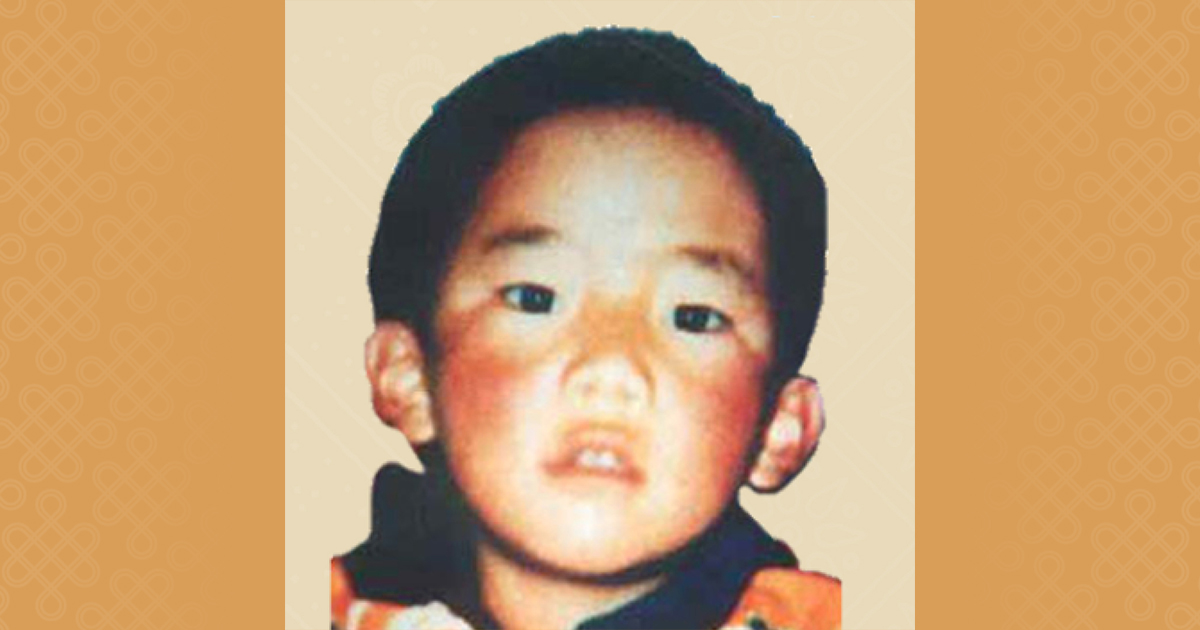
Gedhun Choekyi Nyima was six years old when the Dalai Lama recognized him as the reincarnation of the 10th Panchen Lama in May 1995. He and his family subsequently disappeared from public view. Chinese authorities have stated that he is living a normal life and does not wish to be disturbed, but his circumstances have not been independently verified in public.
The Chinese government subsequently installed Gyaltsen Norbu as its preferred candidate in December 1995. This intervention placed the succession of one of Tibetan Buddhism’s most important religious institutions under direct state authority.
The distinction is fundamental: Gyaltsen Norbu is the Chinese government-appointed Panchen Lama, while Gedhun Choekyi Nyima is the Panchen Lama recognized by the 14th Dalai Lama. Beijing’s appointment does not erase the history of the disputed succession or the unresolved disappearance of the Dalai Lama-recognized child.
The controversy demonstrates how the Chinese Communist Party has sought to control the selection and public representation of Tibetan Buddhist leadership. By determining which candidate receives official recognition and access to religious institutions, Beijing can promote a religious authority whose public role is compatible with its political objectives.
Norbu’s latest call for Tibetan religious activities to align with the Party’s agenda must be understood within this broader context of state intervention in Tibetan Buddhism.
The Historical Importance of the Panchen Lama Institution
The Panchen Lama is one of the most influential spiritual figures in Tibetan Buddhism. The institution is historically associated with Tashilhunpo Monastery in Shigatse, which was founded in 1447 by Gendun Drup, later recognized as the First Dalai Lama.
The Panchen Lama lineage developed within the Gelug school of Tibetan Buddhism and became an important centre of Buddhist scholarship, monastic education, and spiritual leadership. The relationship between the Panchen Lama and Dalai Lama institutions has historically been significant, including their roles in recognizing the reincarnations of their respective lineages.
The position is therefore much more than an administrative title. It carries religious authority rooted in centuries of Tibetan Buddhist tradition.
China’s intervention in the succession process has created a serious conflict between state-imposed authority and Tibetan religious recognition. For Tibetan Buddhists who reject Beijing’s appointment, the controversy concerns the right of their religious tradition to determine its own spiritual leadership without political interference.
The dispute also has implications for the future of Tibetan Buddhism. If the Chinese government can impose its preferred candidate for the Panchen Lama institution, it may seek to exercise similar influence over other major religious successions, including that of the Dalai Lama.
This makes the Panchen Lama controversy central to the broader struggle over religious freedom and the preservation of Tibetan cultural identity.
The 10th Panchen Lama: A Legacy of Tibetan Concerns Under Chinese Rule
The history of the 10th Panchen Lama, Lobsang Trinley Lhundrub Chökyi Gyaltsen, provides an important contrast to the current political role of Gyaltsen Norbu.
The 10th Panchen Lama lived through the establishment of Chinese Communist Party rule in Tibet and the profound upheavals that followed. Although he held official positions within the Chinese political system, he also raised serious concerns about the suffering of Tibetans and the consequences of state policies.
In 1962, he submitted the document widely known as the 70,000-character petition, which criticized the damaging effects of Chinese policies in Tibet and described the hardships experienced by Tibetan people. His willingness to raise these concerns brought him into conflict with the Chinese leadership, and he subsequently faced political persecution.
His experience illustrates the difficult position Tibetan religious leaders have occupied under Chinese rule. Official status within the Chinese political system did not eliminate the responsibility some leaders felt to speak about the circumstances of Tibetan society.
The 10th Panchen Lama also played a role in agricultural development. According to China Daily’s October 8, 2021, report, he brought quinoa seeds to Tibet after receiving them as a gift during a visit to Bolivia in 1985. Those seeds helped initiate research and cultivation trials in the region.
His legacy is consequently significant in both religious and social history. It also underscores the difference between a Tibetan religious leader’s contribution to Tibetan society and the use of religious authority to promote the political priorities of the Chinese state.
Gyaltsen Norbu’s Activities in Shigatse
The September meeting took place in Shigatse, the traditional home of the Panchen Lama institution and the location of Tashilhunpo Monastery.
According to the reported account, Norbu arrived in Lhasa by air from Beijing, his state-assigned home, on July 30, 2026. He subsequently travelled by road to Shigatse on August 24.
During his time in the region, he reportedly carried out religious activities and visited Tibetan Buddhist monasteries in Kangmar, Sagya, Xaitongmoin, and Bainang counties, as well as Sangzhuzi District. These visits included paying homage to the Buddha, delivering Buddhist teachings, and conducting social research.
He also presided over the fifth council meeting and a chairperson’s office meeting of the Shigatse Development Fund, attending other events organized by the fund.
The range of activities illustrates how Norbu’s official role combines religious appearances with participation in state-linked development initiatives. His presence at monasteries provides a public representation of religious authority, while his involvement in development organizations connects that authority to broader administrative and economic priorities.
However, official visits and public ceremonies cannot resolve the underlying dispute over his appointment. Nor do they establish that Tibetan Buddhists are free to determine their religious leadership independently of the Chinese state.
The significance of his activities lies in the broader political context in which they occur: Beijing is seeking to demonstrate that Tibetan Buddhist institutions and their leadership operate within the framework established by the Chinese Communist Party.
Quinoa Cultivation and the Legacy of the 10th Panchen Lama
On September 17, Norbu visited a quinoa planting and processing base in Sagya County, where he inspected the crop growing in the fields.
Quinoa was first cultivated in Tibet in 1988, after the Tibet Agriculture and Animal Husbandry University introduced three varieties from Bolivia. The development followed the 10th Panchen Lama’s visit to Bolivia in 1985, during which he received quinoa seeds as a gift.
China Daily reported in 2021 that the seeds he brought back helped catalyze research and cultivation trials in Tibet.
This agricultural history offers an example of international exchange and the contribution of the 10th Panchen Lama to regional development. It also demonstrates that the institution’s history encompasses more than religious ceremonies and political administration.
Agricultural research and economic development can benefit Tibetan communities. Nevertheless, such activities must be considered separately from the question of religious freedom. Development initiatives do not resolve concerns about the Chinese government's control over Tibetan Buddhist institutions, religious succession, or cultural identity.
The legacy of the 10th Panchen Lama is particularly relevant because his life included both participation in official structures and efforts to raise concerns about the treatment of Tibetans. His history cannot be reduced to a simple endorsement of Chinese state policy.
The Ethnic Unity and Progress Promotion Law and the Assimilation of Tibet
Norbu’s September 30 statement explicitly connected religious work with the Ethnic Unity and Progress Promotion Law, making the relationship between religious institutions and state-defined national identity central to the latest development.
The Chinese government presents ethnic unity as a means of strengthening national cohesion. However, in Tibet, policies that require institutions to conform to an officially prescribed national identity raise concerns about the erosion of distinct Tibetan traditions.
Tibetan identity encompasses language, literature, history, religious practices, and cultural institutions that have developed over centuries. Tibetan Buddhism has played a particularly important role in preserving this heritage and transmitting it between generations.
When monasteries and religious organizations are expected to align their work with the objectives of the Chinese Communist Party, their ability to function independently becomes a serious concern. Religious institutions risk being transformed from centres of Tibetan spiritual and cultural life into instruments for promoting state policy.
The implications extend beyond senior religious leaders. Monastic education, the teaching of Buddhist philosophy, the preservation of Tibetan religious literature, and the relationship between younger generations and their cultural heritage are all connected to the autonomy of religious institutions.
The central question is whether Tibetan Buddhism can retain its distinct identity when its public institutions are expected to promote a political agenda established by Beijing.
For Tibetans, protecting their religious heritage requires more than preserving monastery buildings or organizing official ceremonies. It requires the freedom to maintain their traditions and determine their religious future without political coercion.
Conclusion: Tibet’s Religious Future Must Not Be Dictated by Beijing
Gyaltsen Norbu’s call for all religious and other work in Tibet to align with the Chinese Communist Party’s agenda highlights the continuing conflict between Beijing’s political priorities and Tibetan religious autonomy.
The Panchen Lama institution has a long history within Tibetan Buddhism, but its succession became the subject of direct Chinese government intervention in 1995. The appointment of Gyaltsen Norbu, following the Dalai Lama’s recognition of Gedhun Choekyi Nyima and the subsequent disappearance of the child and his family from public view, remains central to the controversy.
Norbu’s latest remarks bring this unresolved dispute into the present. His call for religious institutions to study and promote the Ethnic Unity and Progress Promotion Law illustrates how the Chinese government expects Tibetan religious life to operate within its political framework.
The history of the 10th Panchen Lama further demonstrates that Tibetan religious leadership has existed in a complicated relationship with Chinese state power. His criticism of policies that harmed Tibetans remains an important part of the institution’s history.
Tibet’s religious traditions are not merely administrative components of the Chinese state. They are part of a distinct cultural and spiritual heritage sustained by Tibetan communities across generations.
The future of Tibetan Buddhism must respect Tibetan religious traditions and the right of Tibetan Buddhists to determine their own spiritual leadership. State-appointed authority cannot erase the disputed succession, and official promotion of national unity cannot substitute for genuine religious freedom.
The Panchen Lama controversy is ultimately about who has the authority to determine the future of Tibetan Buddhism: the religious tradition and the people who sustain it, or a government seeking to bring religion into alignment with its political objectives.