Solar Expansion on the Tibetan Plateau Raises Questions About the Future of Pastoral Life
Tibet Rights Collective | November 5, 2026
China’s drive to blanket the Qinghai-Tibet Plateau with solar farms is bringing income to some herders while raising serious concerns about the survival of Tibetan pastoral traditions, according to recent reporting by Reuters.
A renewable energy frontier
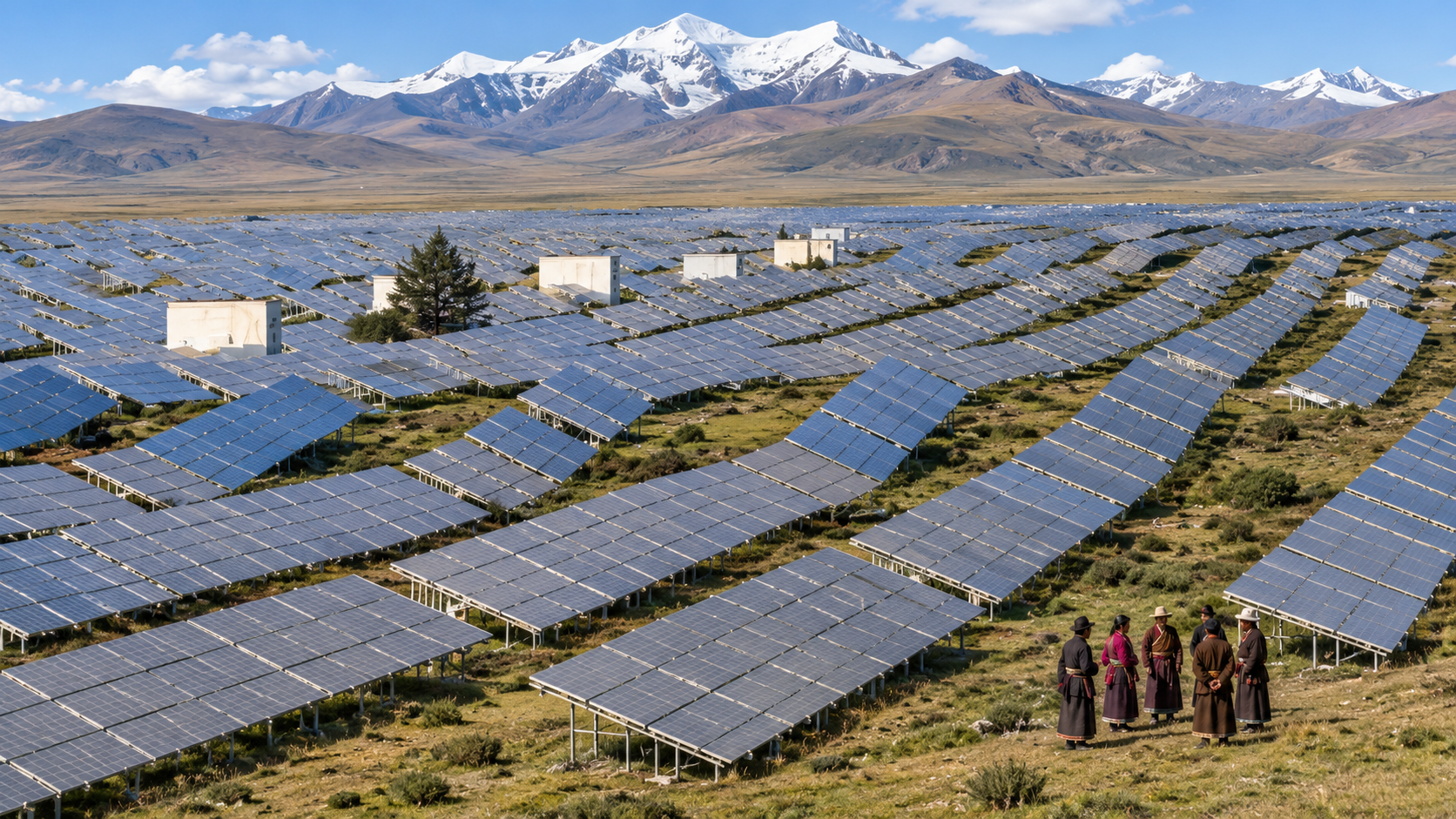
The plateau, often called the roof of the world, has been home to nomadic herding communities for thousands of years. It is now central to Beijing’s clean energy plans. One study estimates the region holds nearly half of China’s total solar potential. Solar became the country’s largest source of installed power capacity in July, and authorities aim to expand wind and solar generation by another 53 percent over the next five years.
In Gonghe County in Qinghai, a single solar complex covers about 60,000 hectares. A safety supervisor at a State Power Investment Corporation project in neighboring Hainan Prefecture told the reporter that sheep grazing among the panels cuts mowing costs. He described the arrangement as a win-win, with the electricity sent to major cities such as Beijing and Shanghai.
Gains for some herders
Some shepherds report real benefits. One 25-year-old herder said his income has climbed to between 50,000 and 60,000 yuan, up from 10,000 to 20,000 under the old way of herding, and that he can now let his flock return to the pen on its own each evening. Another shepherd, 43, said he manages 700 to 800 animals largely by himself and estimates his annual earnings have risen eight-fold to roughly 80,000 yuan.
State media reported that 6,330 households across five townships had benefited from 56 grazing sites in Hainan by July. It did not say how many of those households were actually given access to graze.
Concerns over livelihoods and consent
Researchers and advocates describe a more troubling picture. Tsewang Dorji of the Tibet Policy Institute in Dharamsala said that although animals can find some grazing near the panels, these spaces are not suitable for sustaining a nomadic livelihood. A researcher who studies conservation and new energy infrastructure on the plateau, and who asked for anonymity to protect local collaborators, said residents have very little say when pastureland is converted to solar projects. The researcher added that fenced installations break up formerly open rangeland, making it harder to watch over livestock.
The scale of access also appears limited. Gonghe authorities said in 2024 that sheep from just 16 households were permitted to graze in a solar park for part of the year. Mandie McKeown of the UK-based Foundation for Gaia said only a small number of nomads were given token grazing work, while goats and yaks were generally excluded. In her assessment, what is happening is not pastoralism as it has traditionally been practiced.
There are also quality-of-life concerns. Anthropologist Sanggay Tashi of the University of Colorado Boulder wrote in June that people in Qinghai described a persistent, unsettling noise from wind passing through the solar farms’ posts and wires, which disturbed both people and animals.
Government records from 2017 also show a complaint that photovoltaic stations in Gonghe had damaged grasslands and left livestock with little to eat. Officials said an investigation found the claim untrue and noted that grazing was not permitted in that area. Qinghai authorities did not respond to Reuters’ requests for comment.
Why this matters
Tibetan nomads have already faced large-scale resettlement. In the early 2000s, thousands were moved into rural townships under policies justified as reversing ecological degradation. The rapid growth of solar development adds a new pressure on herding communities that have already seen their relationship with the land reshaped from above.
Clean energy is a worthy goal, and the income gains reported by some herders should not be dismissed. But the question for Tibetans is who decides, who benefits, and whether the people who have stewarded these grasslands for generations have a meaningful voice in how their land is used. Without genuine consultation and consent, even green development risks hastening the erosion of Tibetan culture and livelihoods.
This article draws on reporting by Andrew Silver for Reuters, published November 4, 2026.