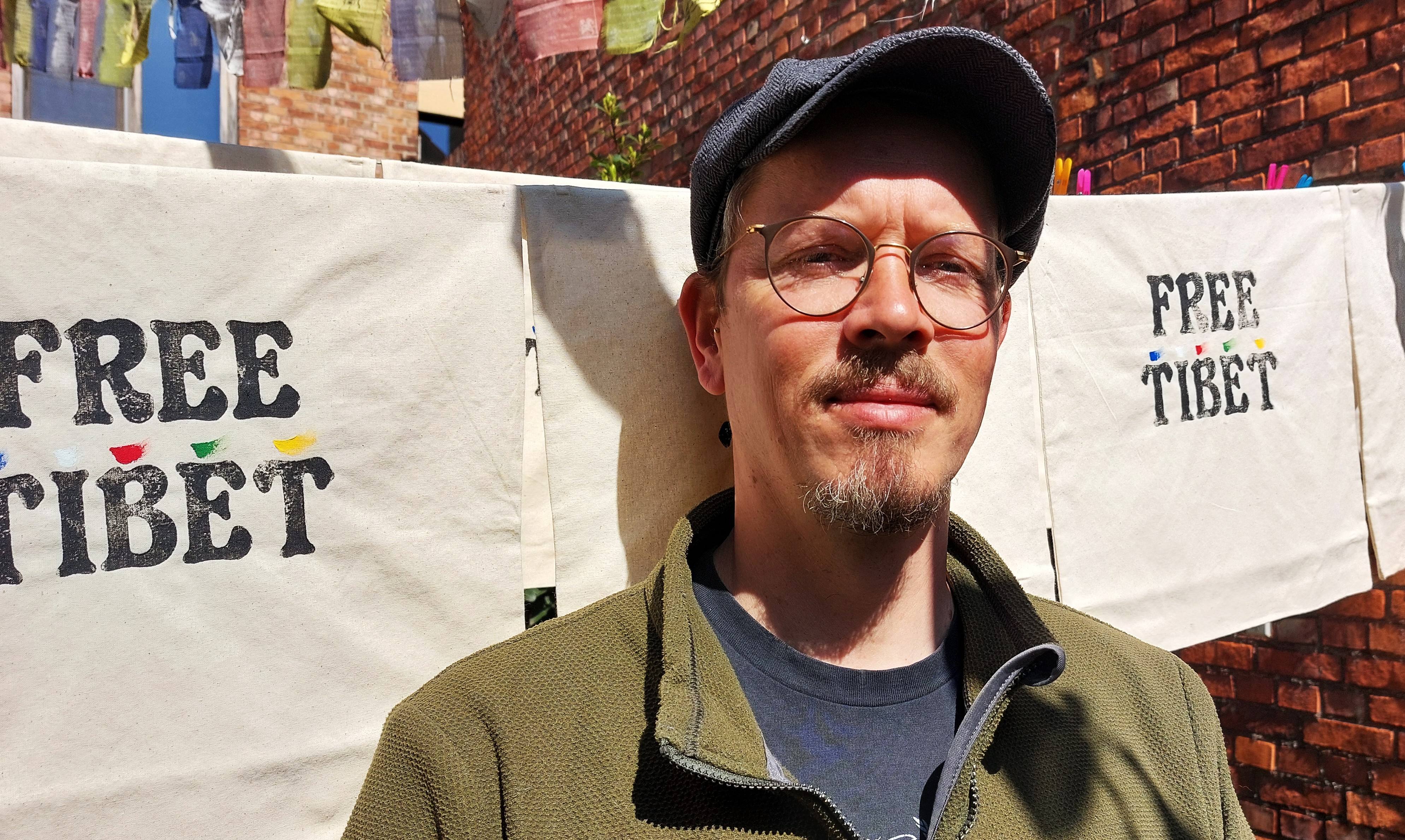
Han Vandenabeele is the founder of LUNGTA – Active for Tibet
The People's Republic of China and dissent - never a happy marriage. On a domestic level, the relationship could easily be called toxic, oppressive, even violent. For the economic and authoritarian superpower, one thing is clear: it’s my way or the highway. And that highway doesn’t stop at national borders. It barrels straight through to the E40, a major European highway running from France to Kazakhstan. Tibetans in diaspora have known this for a quite a while. From India to Belgium, Big Xi is watching you. There’s little escape from the Chinese regime’s tentacles - no exit from the motherland.
Historical context
Tibet has had a long and complex relationship with the imperial forces that ruled China. Dynasties with both Han Chinese and foreign rulers - such as the Mongol Yuan Dynasty (1279–1368) or the Manchu Qing Dynasty (1644–1912) - claimed the Mandate of Heaven. Periods of de facto independence, degrees of autonomy, and imperial control alternated with shifting power balances across the Asian interior. As dharma took firmer root on the roof of the world, soldiers made way for Buddhist monks. Tibet held the highest religious authority but increasingly relied on foreign powers for political and military support.
This chö-yön, or patron-priest relationship, flourished but also laid the groundwork for later Chinese claims over Tibet as an historical part of the empire. During the Qing, China’s influence expanded through the amban, the imperial envoy in Lhasa, who meddled in Tibetan politics. His presence marked an early form of external control, an historical precursor to the transnational aggression China now deploys against the Tibetan diaspora.
Geopolitical arena
By the late 19th century, Tibet entered the international geopolitical stage as a pawn in the Great Game. The British Empire saw Tibet as a buffer state against Tsarist expansion. Backed by Maxim guns, a British military expedition secured trade interests and influence in Lhasa. Meanwhile, weakened by internal strife and the aftermath of the Opium Wars, the Qing missed the boat to modernity. The Chinese Republic emerged in the so-called Century of Humiliation - an era of subjugation by foreign powers that still fuels China's hypersensitivity toward sovereignty and territorial integrity today. A national trauma with transnational repression as its prescription.
After the Qing dynasty collapsed, Tibet declared itself independent, resulting in a period of de facto - but not internationally recognized - autonomy. That ended abruptly with the founding of the People’s Republic of China and its annexation (or "peaceful liberation" according to official Chinese discourse) of Tibet. Imperial influence gave way to Maoist state control. The failed 1959 uprising and the Dalai Lama’s escape to India marked the beginning of the Tibetan diaspora. It also marked the beginning of China’s relentless effort to monopolize the historical and political narrative, far beyond its borders.
A struggle over narrative
The occupation of Tibet provides China not only with military and economic leverage, but access to vital water sources that feed the largest rivers in Asia. The implications are regional and geopolitical. With physical control over Tibet secured, the front line has shifted to control over history, present and even the future. This is preemptive repression aimed at owning the story: questioning the legitimacy of the Tibetan government-in-exile (the Central Tibetan Administration or CTA), smear campaigns against the Dalai Lama, battles over his reincarnation, and the dissemination of alternative truths - Tibet as an inseparable part of the Chinese motherland.
The digital highway provides new tools for old tactics. Through platforms like WeChat, TikTok and others, dissenting voices are monitored and intimidated. Guided by algorithms, Beijing’s long arm now reaches directly into Tibetan living rooms in the Low Countries. The relatively small size of the diaspora stands in stark contrast to the intensity and obsessive nature of China’s approach. Activists, NGOs, even Buddhist institutions are frequent targets of cyberattacks and malware campaigns. Digital fingerprints trace back to Chinese infrastructure or proxies - evidence of systematic orchestration. According to the CTA’s security department, up to 80% of exiled Tibetans have experienced some form of transnational repression.
From Brussels to The Hague, from newcomers like Tashi to second-generation intellectuals like Nyima - the testimonies I’ve encountered as an activist tell a remarkably consistent story and saw a spike after the widespread 2008 uprising on the Tibetan plateau. China's playbook is by now familiar: sneaky, unoriginal, but undeniably effective at sowing fear. It shows up in anonymous phone calls, threats against family back home, the (self-)censorship of critical voices, or unexplained visa denials. Chinese embassies and consulates operate far beyond diplomacy - serving as nodes of surveillance. Activists are photographed (myself included), followed, and sometimes even physically intimidated at protests.
Pressure cooker diplomacy
China spares no effort in normalizing its picture of Tibet as a “liberated” region. Even the use of the name “Tibet” is under pressure, as Beijing aggressively promotes the Chinese term Xizang, gaining traction even among Western museums. Its growing global influence comes hand in hand with diplomatic and economic pressure on governments - many of which have grown more hesitant to meet publicly with the Dalai Lama or CTA officials. The promise of free speech and protection once associated with exile is proving more porous than hoped.
Lurking in the shadows of Chinese state power is the United Front Work Department (UFWD). Originally a Maoist tool to unite internal enemies, it now plays a key role in Beijing’s global strategy of control. In the Tibetan context, it has a dual mission: suppress so-called separatism and promote a Party-approved version of Tibetan identity. Through infiltration, psychological or emotional manipulation, intimidation and digital coercion, the UFWD creates a climate of fear. It seeks to divide Tibetans inside and outside Tibet, discredit advocates and destabilize both the diaspora and the Free Tibet movement.
Diaspora as a space for resistance
China’s long arm may reach far, but the Tibetan community is not without resistance and it’s ready for an arm-wrestling match. That resistance takes many forms: from diplomatic lobbying by the CTA to grassroots activism by youth organizations like Students for a Free Tibet. From public protests to silent commemorations. From preserving language and religion to creating digital counter-narratives on social media.
Even under threat or perhaps because of it, the political maturity of the diaspora continues to grow. Children of first- and second-generation refugees become spokespersons, bridge-builders or activists. They speak the language of their host countries and of their ancestors. They operate in parliaments, universities or on the streets and forming alliances with Uyghurs, Hongkongers and dissident Chinese voices. What unites them? A shared history of oppression and a shared future that Beijing is determined to strangle in its crib.
No totalitarian power invests this much in narrative control - unless that narrative poses a genuine threat. This calls for international vigilance, legal protection for diaspora communities and a principled defense of freedom of speech and association - even when it runs counter to economic interests.
Beijing may cross borders with malware and shadow diplomacy, but it runs into something no algorithm can neutralize: the story of resistance. Not grand, not epic, but persistent. And perhaps that’s a control-obsessed regime’s worst nightmare: a people that, against all odds, continues to endure and to remember.
By Han Vandenabeele
Han Vandenabeele is the founder of LUNGTA – Active for Tibet and has been advocating for the rights of Tibetans for over 20 years. LUNGTA (www.lungta.be) is a TSG based in Belgium and is also a member of the International Tibet Network.
The original version of this article was published in Dutch in Loving Geopolitics Magazine No. 7, Summer 2025 (www.lovinggeopolitics.nl).