Tibet Is Dead to Washington?
Trump’s Beijing Visit Buries the Cause in Silence
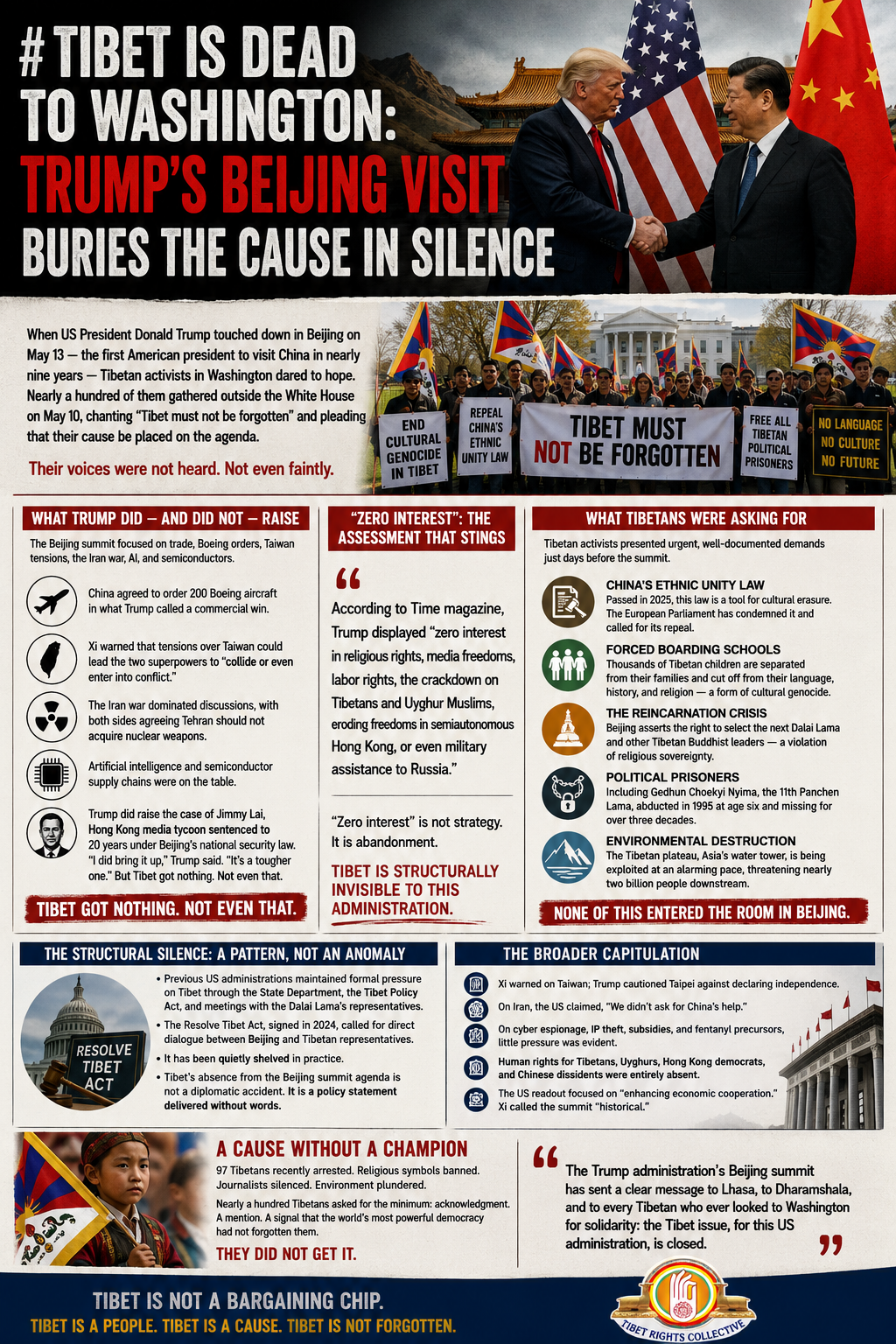
When US President Donald Trump touched down in Beijing on May 13, the first American president to visit China in nearly nine years, Tibetan activists in Washington dared to hope. Just days before his departure, nearly a hundred Tibetans gathered outside the White House chanting “Tibet must not be forgotten” and urging the US president to raise Tibet during his meeting with Chinese President Xi Jinping.
Their voices were not heard.
Trump’s two day summit with Xi Jinping, held at the Great Hall of the People and Zhongnanhai on May 14 and 15, focused on trade disputes, Boeing aircraft orders, Taiwan tensions, the ongoing Iran war, and the case of jailed Hong Kong media tycoon Jimmy Lai.
Tibet received no mention in any official American statement.
Not a single word.
What Trump Raised And What He Ignored
Trade dominated the summit. China agreed to purchase 200 Boeing aircraft in what Trump described as a major commercial success.
Taiwan tensions also took center stage. Xi Jinping warned that conflict over Taiwan could force the United States and China into direct confrontation.
The Iran war featured heavily as both sides discussed nuclear concerns and regional stability. Artificial intelligence and semiconductor supply chains were also discussed.
Trump did briefly raise the case of Jimmy Lai, the Hong Kong publisher imprisoned under Beijing’s national security law. Trump later admitted China’s response on Lai’s release was “not positive.”
Even a limited mention was made.
Tibet received nothing.
Zero Interest In Tibet
One of the strongest assessments of Trump’s position came from observers in Beijing itself. According to Time magazine, Trump showed “zero interest” in religious freedom, media rights, Tibetans, Uyghurs, Hong Kong freedoms, or broader human rights concerns in China.
The phrase “zero interest” reflects something deeper than diplomatic caution. It signals abandonment.
Tibet was not postponed for another discussion. Tibet was absent altogether.
When the leader of the world’s most powerful democracy meets the leader responsible for the systematic assimilation of Tibet and refuses even to acknowledge the issue, the silence becomes political.
What Tibetans Asked For
Before Trump’s departure, members of the Regional Tibetan Youth Congress of New York and New Jersey gathered outside the White House demanding action on several urgent issues.
China’s Ethnic Unity Law
Passed in 2025, critics say the law is designed to erase Tibetan identity by replacing Tibetan language, religion, and culture with Communist Party ideology. The European Parliament has condemned the law and called for its repeal.
Forced Boarding Schools
Thousands of Tibetan children are separated from their families and placed in state run boarding schools where they are denied education in their native language and disconnected from Tibetan culture and religion.
The Reincarnation Crisis
China claims authority to select the next Dalai Lama and other Tibetan Buddhist leaders, a move Tibetans see as a direct attack on religious freedom and spiritual sovereignty.
Political Prisoners
Gedhun Choekyi Nyima, the 11th Panchen Lama, was abducted by Chinese authorities in 1995 at the age of six and has not been seen publicly since. His disappearance remains one of the world’s longest unresolved cases of enforced disappearance.
Environmental Destruction
The Tibetan plateau, often called Asia’s water tower, supplies water to nearly two billion people across Asia. Environmental exploitation in Tibet continues at an alarming pace.
None of these issues entered the summit discussions in Beijing.
A Pattern Of Silence
Trump’s silence on Tibet was not accidental. It reflects a broader pattern within the current administration.
Previous US administrations, despite limitations and compromises, maintained at least some diplomatic pressure through the Tibet Policy Act, State Department initiatives, and engagement with representatives of the Dalai Lama.
The Resolve Tibet Act signed in 2024 called for dialogue between Beijing and Tibetan representatives. Yet in practice the policy has largely disappeared from the current administration’s priorities.
Tibet’s absence from the Beijing summit was not an oversight.
It was a message.
The Larger Capitulation
The summit highlighted broader American concessions.
Xi Jinping warned Washington over Taiwan while Trump publicly cautioned Taipei against declaring independence. On Iran, the United States appeared defensive rather than assertive.
Cyber espionage, intellectual property theft, fentanyl exports, and state subsidies received little visible pressure.
Human rights issues involving Tibetans, Uyghurs, Hong Kong activists, and Chinese dissidents were almost entirely absent from official discussions.
The American statement emphasized “economic cooperation.”
Xi Jinping described the summit as “historical.”
For Beijing, it was a strategic victory.
For Tibet, it felt like abandonment.
A Cause Without A Champion
Conditions inside Tibet continue to deteriorate.
Chinese authorities recently arrested 97 Tibetans under cybersecurity laws widely viewed as tools for political repression. Religious symbols are increasingly restricted. Journalists face severe censorship. Environmental exploitation across the Tibetan plateau continues to accelerate.
For decades, the United States positioned itself as one of Tibet’s strongest democratic supporters, providing refuge and support to Tibetan communities in exile. India meanwhile has remained the true second home of the Tibetan people, hosting the Central Tibetan Administration in Dharamshala for more than sixty years.
Yet today many Tibetans feel Washington has stepped away from the issue entirely.
The protesters outside the White House asked for something simple.
Acknowledgement.
Recognition.
A signal that Tibet had not been forgotten.
They did not receive it.
The Beijing summit delivered a clear message to Tibetans in Lhasa, Dharamshala, and across the world.
For this administration, Tibet is no longer a priority.