Guru Padmasambhava: The Lotus-Born Master and His Sacred Bond with Tibet
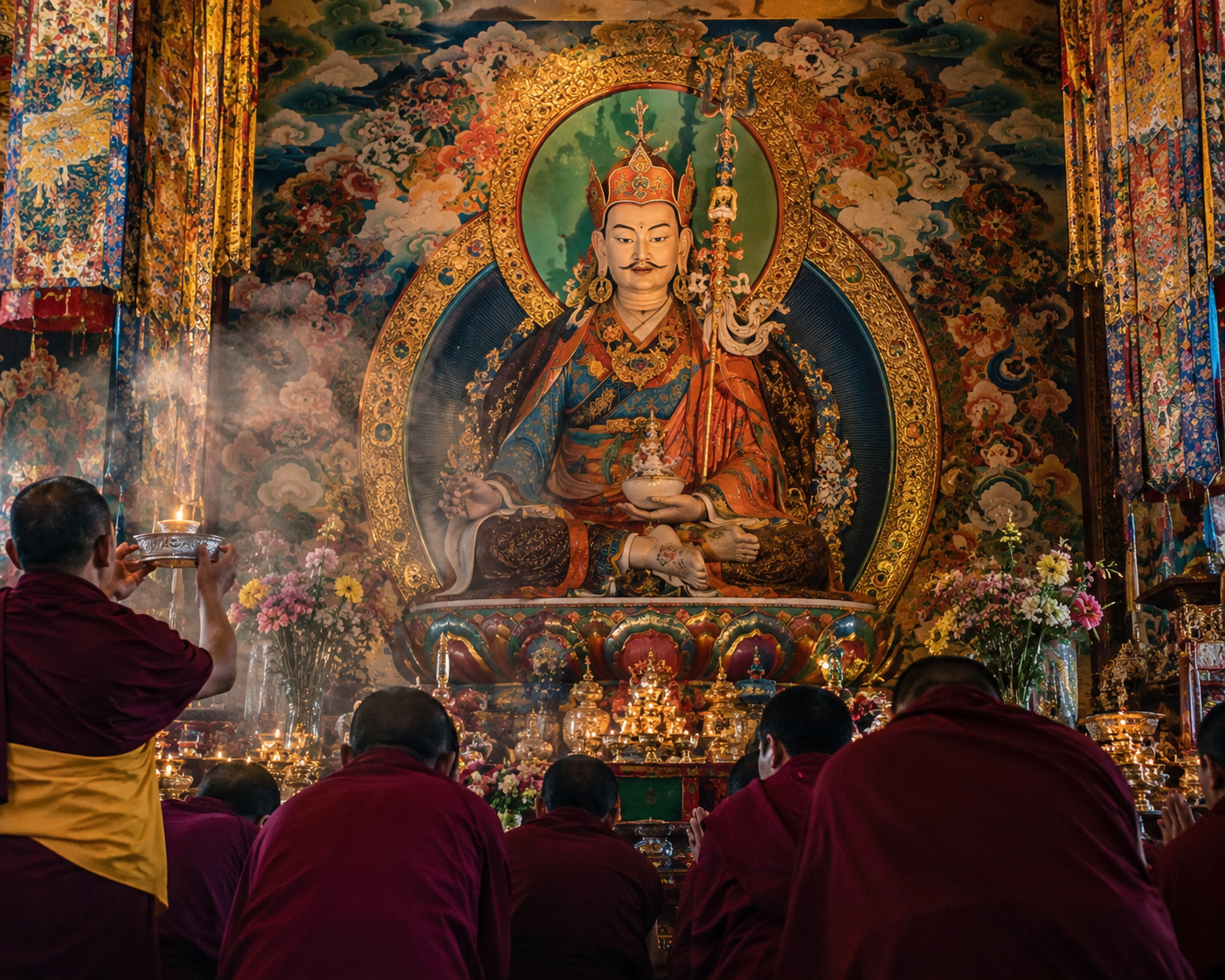
Guru Padmasambhava, revered as Guru Rinpoche, meaning "Precious Master," stands as one of the most towering spiritual figures in the history of Tibetan Buddhism. Regarded by millions as a "second Buddha," his life, teachings, and mystical legacy have shaped the spiritual soul of Tibet for over twelve centuries.
Origins and Early Life
Padmasambhava, whose name literally means "Lotus-Born," is believed to have miraculously appeared as an eight-year-old child on a lotus flower in the middle of Dhanakosha Lake, in the ancient kingdom of Oddiyana, a region traditionally identified with parts of modern-day Pakistan and Afghanistan. Unlike ordinary beings, he is said to have been born without a human mother or father, embodying the pure manifestation of enlightened wisdom from the very beginning.
The Journey to Tibet
In the 8th century CE, Tibet's Buddhist king Trisong Detsen invited the Indian master Padmasambhava to help establish Buddhism in Tibet. At the time, the land was heavily influenced by the indigenous Bon religion and was believed to be inhabited by powerful spirits and demons hostile to the Dharma.
Padmasambhava accepted the royal invitation and made the long and arduous journey to the Himalayan kingdom. According to Tibetan tradition, as he traveled through Tibet, he subdued and transformed countless malevolent spirits, not by destroying them, but by converting them into Dharma protectors, guardians of the Buddhist teachings. This unique approach blended seamlessly with Tibetan spiritual sensibility and became one of the hallmarks of Vajrayana Buddhism.
Founding of Samye Monastery
One of Padmasambhava's greatest achievements in Tibet was the establishment of Samye Monastery, Tibet's very first Buddhist monastery, around 779 CE, built in collaboration with King Trisong Detsen and the Indian scholar Shantarakshita. Samye became the cradle of Tibetan Buddhism, the place where the first Tibetan monks were ordained and where sacred texts were translated from Sanskrit into Tibetan. This monumental act laid the foundation for an entire civilization rooted in Buddhist philosophy.
Teachings and Hidden Treasures
Padmasambhava spent years traveling across Tibet, Bhutan, Nepal, and the broader Himalayan region, transmitting profound Vajrayana teachings. Knowing that future generations would need spiritual guidance in troubled times, he concealed thousands of sacred teachings known as Termas, or "hidden treasures," within rocks, lakes, the earth, and even in the minds of destined disciples.
These Termas were meant to be discovered centuries later by spiritually awakened beings called Tertöns, or treasure revealers, who would decode them at the right moment in history. This tradition of hidden treasures is unique to Tibetan Buddhism and reflects Guru Rinpoche's profound compassion for all future generations.
The Nyingma Tradition
Padmasambhava is considered the founding father of the Nyingma school, the oldest of the four major schools of Tibetan Buddhism. The Nyingma tradition places Guru Rinpoche at the very heart of its practice, venerating him as the embodiment of all Buddhas. His teachings on Dzogchen, the "Great Perfection," a path to direct recognition of one's natural mind, remain among the most revered and practiced in Tibetan Buddhism to this day.
The Tshechu Festival
The deep love Tibetans hold for Guru Rinpoche is perhaps best expressed through the vibrant Tshechu festival, celebrated on the tenth day of each lunar month, days considered especially blessed by Padmasambhava's enlightened activities. Marked with elaborate mask dances known as Cham, sacred rituals, prayers, and community gatherings, Tshechu is both a religious observance and a living cultural celebration. Across Tibet, Bhutan, Nepal, Sikkim, and the Himalayan diaspora worldwide, these festivals are occasions of immense spiritual merit and communal joy.
Legacy Among Tibetan Exiles
For Tibetans living in exile, particularly in communities in Dharamsala, Shimla, Bylakuppe, and other parts of India and Nepal, Guru Padmasambhava holds even deeper significance. In times of hardship, displacement, and uncertainty, his image as a fearless master who transformed darkness into light offers immense solace and courage. Prayers dedicated to him are regularly offered for world peace, harmony, and the preservation of Tibetan culture and religion.
His most famous mantra, Om Ah Hum Vajra Guru Padma Siddhi Hum, is chanted daily by millions of Buddhists and is believed to carry immense blessings for both the individual and the world.
Conclusion
Guru Padmasambhava is far more than a historical figure for Tibetans. He is a living spiritual presence, a compassionate protector, and the very embodiment of enlightened power. His mission to bring the light of the Dharma to one of the world's most challenging terrains, his miraculous taming of hostile forces, and his timeless teachings continue to inspire and guide millions of people across the Himalayan world and beyond. In the heart of every Tibetan, Guru Rinpoche is not simply remembered. He is encountered, revered, and loved.