
US tech enabled China’s surveillance empire. Now Tibetan refugees in Nepal are paying the price
By Tibet Rights Collective
Introduction
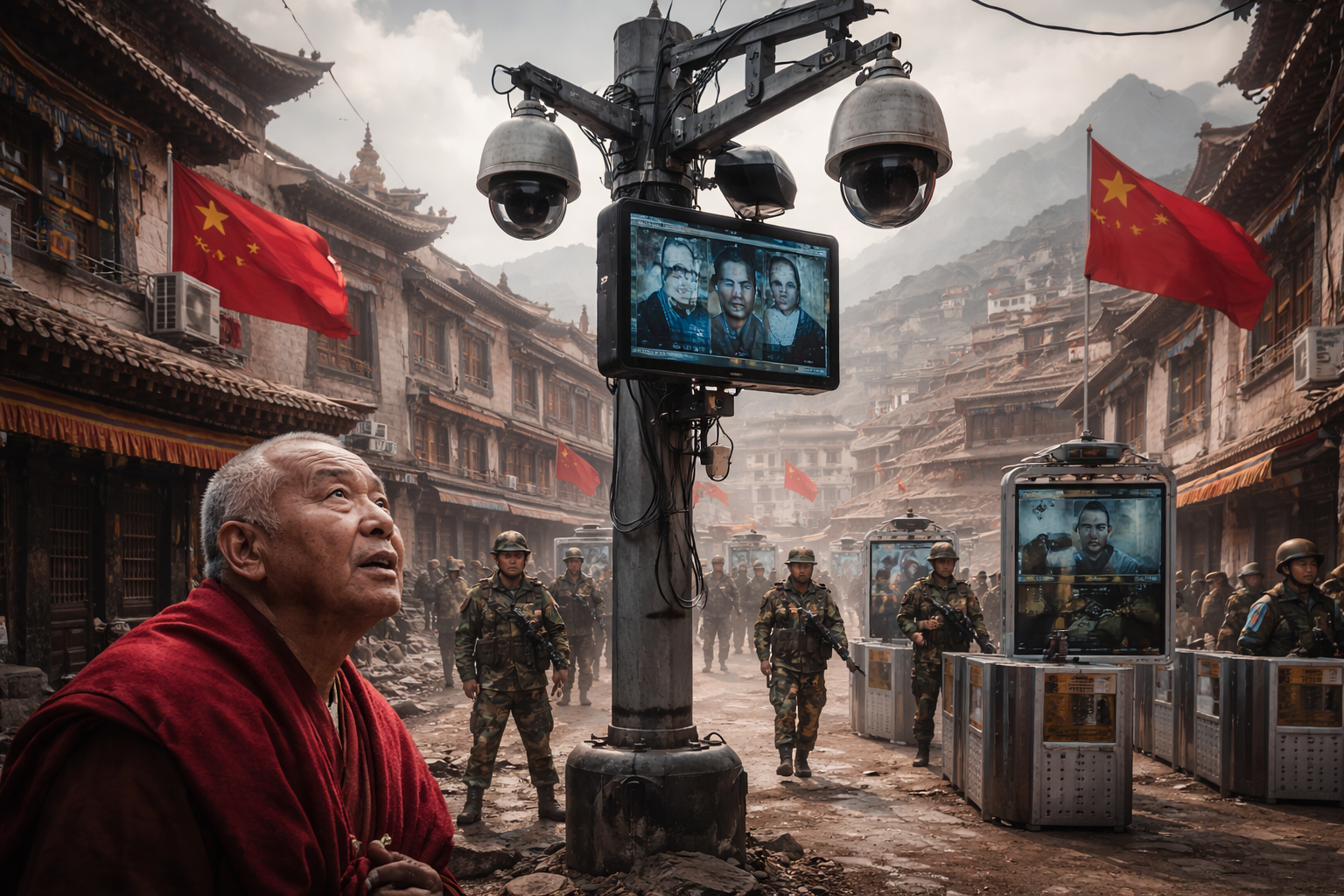
The white dome of Boudhanath rises above the crowded streets of Kathmandu as it has for generations. Crowned by a golden spire and marked with the calm eyes of the Buddha, the stupa has long symbolized refuge for Tibetans fleeing repression in their homeland. For decades, this sacred space represented safety, cultural continuity, and freedom. Today, however, a far more intrusive gaze has taken hold. Thousands of surveillance cameras now monitor the city, turning a place of refuge into a landscape of fear for Tibetan refugees.
Kathmandu under constant watch
Across Kathmandu, CCTV cameras are mounted on traffic lights, rooftops, temples, and street corners. Most of these systems are supplied by Chinese companies and equipped with advanced surveillance features including facial recognition and artificial intelligence. What was once a vibrant center of Tibetan religious and cultural life is now heavily monitored, particularly in areas where Tibetan refugees live and gather. This surveillance has directly contributed to the decline of public Free Tibet activism in Nepal.
Related reporting on expanding surveillance inside Tibet can be found here
https://www.tibetrightscollective.in/news/chinas-smart-construction-sites-expanding-mass-surveillance-network-in-tibet-concerns-over-increased-intrusion-and-oppression
Nepal in China’s global surveillance network
Nepal is now part of a global network of more than 150 countries where Chinese companies export surveillance technology. From Southeast Asia to Africa, these systems are marketed as cost effective solutions for public safety and crime prevention. In reality, they often enable invasive policing and political control. In Nepal, this technology has been deployed most aggressively in Tibetan neighborhoods, border districts, and religious sites, aligning closely with Beijing’s political priorities.
The American roots of digital repression
At the heart of this digital authoritarianism lies a troubling irony. Much of the technology that enabled China to build and export its surveillance empire originated in the United States. For years, American technology companies transferred software, hardware, and expertise to Chinese firms in exchange for access to China’s market. These transfers helped Chinese companies develop the tools that are now used to monitor and silence vulnerable communities across the world, including Tibetan refugees in Nepal.
Shrinking refuge and sealed borders
For decades, thousands of Tibetans crossed the Himalayas into Nepal each year seeking safety. Today, that number has fallen to single digits. Tibetan officials cite tight border controls, Nepal’s growing political alignment with China, and unprecedented surveillance as the main reasons for this drastic decline. Joint border mechanisms and digital monitoring have effectively sealed escape routes that once saved countless lives.
More context on cross border repression can be found in Tibet Rights Collective updates
https://www.tibetrightscollective.in/news/destroying-heaven-the-tragedy-of-larung-gar
Life without rights or security
Surveillance has gone hand in hand with the erosion of legal rights. Many Tibetans in Nepal lack refugee documentation, leaving them unable to work legally, open bank accounts, or travel freely. Activists report being detained in advance of politically sensitive dates such as March 10 and July 6. Predictive policing systems now allow authorities to identify and detain individuals before any protest takes place, silencing dissent before it is visible.
Fear replacing freedom
The impact on daily life is profound. Tibetans describe living with constant anxiety, avoiding public gatherings, and censoring their own speech. Cameras do not merely observe but remember, storing patterns of movement and building digital records of entire communities. As one Tibetan refugee explained, silence has become a strategy for survival.
Additional reporting on repression and surveillance affecting Tibetans can be found here
https://www.tibetrightscollective.in/news
A warning beyond Nepal
The situation facing Tibetan refugees in Nepal is not an isolated case. It is part of a broader global trend in which surveillance technology is used to suppress dissent and control marginalized communities. Enabled in part by past technology transfers from the United States, China’s surveillance model is reshaping societies far beyond its borders.
Conclusion
Nepal has long been known as a place of compassion and refuge. Yet today, under political and economic pressure, it has allowed foreign surveillance systems to undermine the rights and safety of Tibetan refugees. For those who once found shelter beneath the peaceful eyes of Boudhanath, daily life now unfolds under an unblinking digital gaze. For Tibetan refugees in Nepal, the price of a global surveillance empire is paid in lost freedom, shrinking space, and a future clouded by fear.